
Ready to unlock your cells’ potential?
No other teamis as dedicated to advancing cell culture media as Multus. Talk to our mediaspecialists today!


No other teamis as dedicated to advancing cell culture media as Multus. Talk to our mediaspecialists today!
The most widely used cell culture media formulations in biomanufacturing today were developed in the 1950s. DMEM - Dulbecco’s Modified Eagle Medium - was first designed for basic cell biology research. It was not designed for manufacturing biologics, cell therapies, or gene therapies at a commercial scale. Yet it, and formulations like it, remain the default starting point for our industry.
The gap between the demands of modern biomanufacturing and the tools being used to meet them has real consequences. According to FDA data, between 2020 and 2024, 74% of new drugs and biologics in review were rejected on quality/manufacturing grounds.
A typical cell culture basal medium contains 50-70 interacting chemical components such as amino acids, salts, carbon sources, and trace elements. Feed media typically contains fewer components but at higher concentrations. The challenge in modern media development is understanding how these ingredients interact with each other and with the cell line under production conditions.
Testing all possible combinations, even at just three concentration levels per ingredient, would generate more combinations than any team could test manually. The standard response to this problem has been design of experiments (DoE) - a statistical method that reduces the number of experiments needed by varying multiple factors simultaneously.
DoE is a significant improvement over one-factor-at-a-time (OFAT) testing, but it has structural limitations that matter in media development. It assumes linear or polynomial relationships between variables. Cell biology is rarely that clean. When a growth factor interacts with a buffering agent in a way that depends on the concentration of a third component, DoE will miss it. The result is a formulation that performs reasonably, but hasn't been genuinely optimized.
Teams often don't know what they're leaving on the table. A 2025 study validated a better approach: Bayesian optimization. By building probabilistic models of how ingredients interact and using those models to select the next most informative experiment, Bayesian methods can identify optimal formulations using 3-30x fewer experiments than standard DoE. The difference is the ability to navigate complex, non-linear optimization landscapes that conventional methods can't handle.
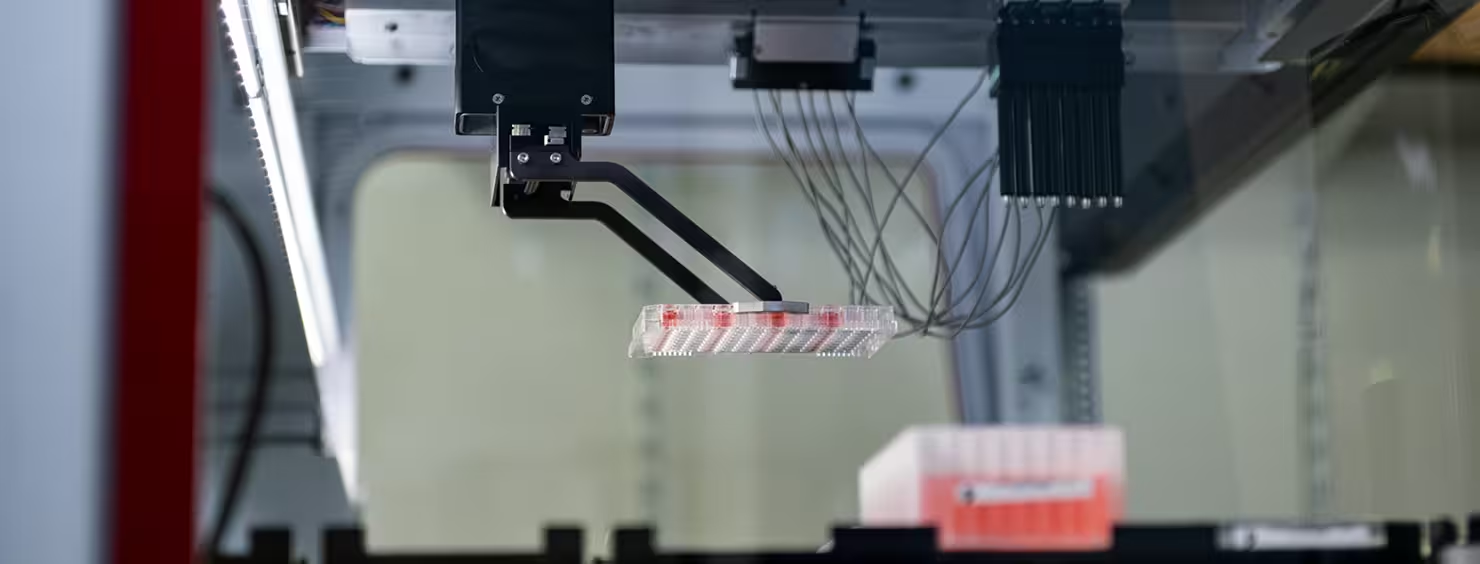
Multus approaches this challenge with MediOP™, our AI-enabled media design platform. It uses Bayesian optimization and high-throughput robotic automation to run thousands of parallel experiments and continuously update predictive models as data accumulates. Rather than testing a small fraction of the formulation space and hoping the best answer is in it, MediOP™ is designed to find the global optimum, not just a local one.
Getting the experimental design right is one of the most high-leverage decisions in any media development program.
HEK293 cells used in viral vector production, T cells and NK cells used in adoptive cell therapies, and iPSC-derived cell types are often not grown in cell-specific media.
As noted in BioPharm International, commercially available media for these cell types are often not chemically defined, may require animal-derived components, and have not been optimized with the same rigor as CHO media.
As of 2025, there were 11 cell and gene therapies approved by the US FDA for cancer treatment. Each relies on a manufacturing process built around cell expansion in culture. The media decisions made during process development directly determine whether the process can scale, whether the product meets release specifications, and what the cost of goods looks like at commercial scale.
The challenge for any team working outside the CHO/mAb space is that they're starting from a less mature foundation. The optimization problem is often more complex, especially because the cells are more sensitive and the definition of "performance" is multidimensional. A media formulation that performs acceptably at 2L shake flask scale may fail to reproduce at 200L or 2,000L bioreactor scale, for reasons related to how cells respond to dissolved oxygen gradients, shear stress, and mixing dynamics - all of which interact with media composition.
Multus approaches this challenge with a cell-type agnostic process. The same platform used to develop CHO media applies equally to T cells, NK cells, viral vector-producing HEK293 cells, and other emerging production systems.
The direction of travel in media development is no longer ambiguous. Merck has built BayBE, a Bayesian Optimization tool for formulation science. Novo Nordisk has ProcessOptimizer. Several of the largest names in biopharma are actively investing in AI-driven upstream process development capabilities. The incumbents have recognized that data-driven experimental design is where the field is going, and they are building towards it.
The pace at which novel cell types are entering development makes this more acute. Bispecific antibodies, ADC payloads, CAR-T cells, NK cells, viral vectors - each requires media development from a less mature starting point than CHO mAbs, and each has a narrower window between process development and clinical or commercial manufacturing.
Multus approaches this with our integrated MediOP™ platform - Bayesian optimization, high-throughput robotic automation, and a proprietary structured dataset of 5+ million data points that grows with every project. It isn't a software layer applied to conventional wet-lab workflows; the experimental execution and the decision-making engine are designed to operate together. That integration is what allows MediOP™ to run thousands of parallel experiments, update its models in real time, and apply learning from previous cell lines to new targets.
Development teams that partner with Multus are accessing a dataset and predictive models that no conventional program can replicate from scratch.
We work with biopharma companies and CDMOs on custom media development for cell types where the standard options haven't kept pace with where the science is going.
Media doesn’t have to be a bottleneck. If your current approach is built on legacy assumptions, you’re likely leaving performance, scalability, and cost improvements on the table without realizing it. Our Media Development Checklist is designed to help you uncover where that’s happening - and what to do next.
Sign up for email updates:

